























“How much does Odoo cost?” sounds like it should have a one-line answer. It doesn’t, but most guides dodge the question entirely by telling you to “check the pricing page.” This one won’t.
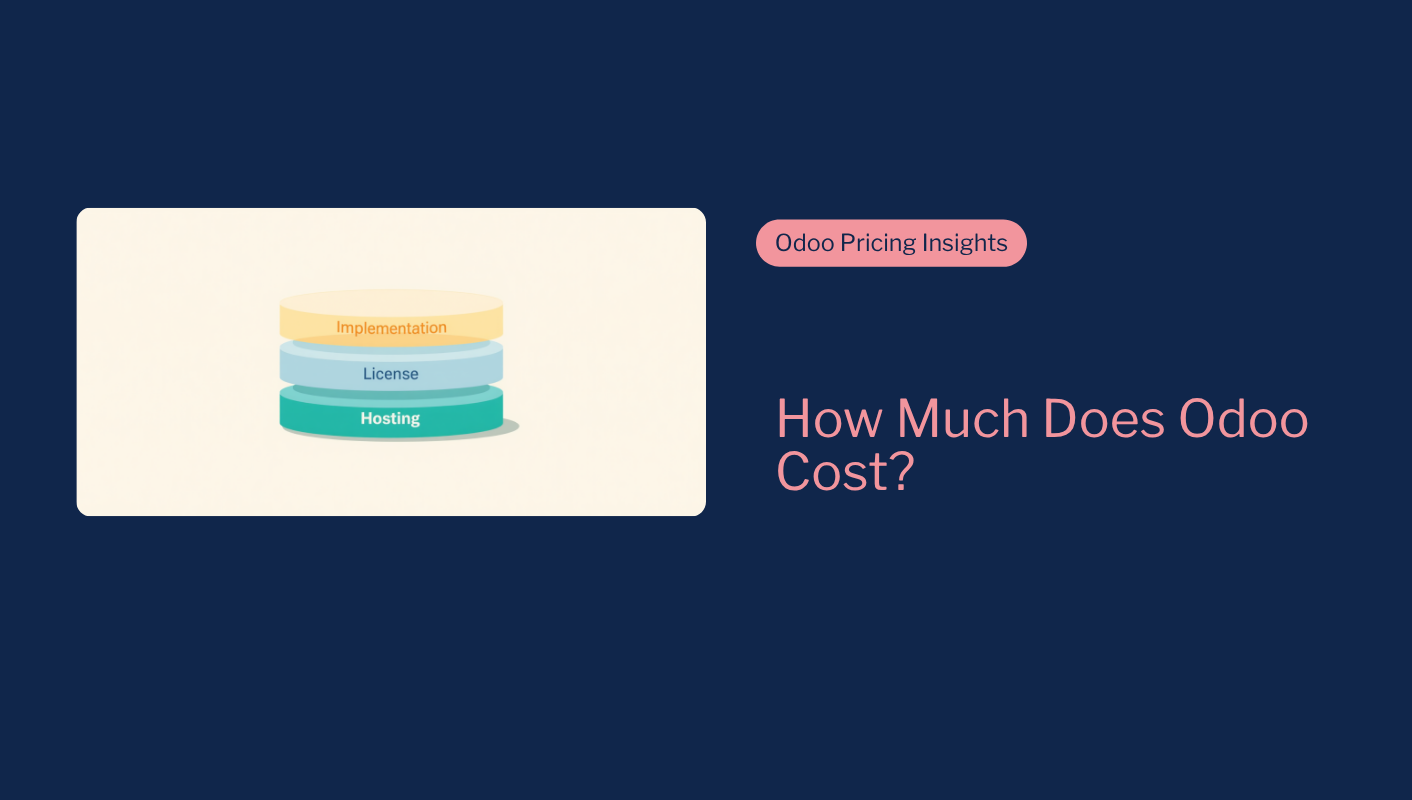
Odoo can be very cheap to start and surprisingly expensive to run, and the difference comes down to choices around the software, not the software itself. The license is often the smallest line item. To price Odoo properly you have to separate two layers: what you pay Odoo for the software, and what you pay to host, implement, and maintain it.
Below is the full breakdown with current 2026 figures, four worked cost scenarios you can verify, and the levers that actually move your bill.
Key Takeaways
- Standard Plan: about $24.90/user/month billed yearly (12-month promo), renewing near $31.10/user/month.
- Custom (Enterprise) Plan: about $49.00/user/month billed yearly, renewing near $61.00/user/month.
- Community Edition: $0 license, but you pay for hosting, maintenance, backups, and upgrades.
- Hosting for a customizable deployment runs from Odoo.sh’s per-worker metered pricing (starting around $70/worker/month plus storage and staging) to flat managed plans from roughly $25/month.
Odoo’s Plans – What They Actually Cost
Odoo’s paid licensing is priced strictly per user, per month, across two tiers: Standard and Custom. Prices below are US rates; Odoo uses geolocation-based pricing across many regional pricelists, so your local figure may differ.
| Plan | Price (yearly billing) | Renewal rate | Customization |
|---|---|---|---|
| Standard | ~$24.90/user/mo | ~$31.10/user/mo | No custom code |
| Custom | ~$49.00/user/mo | ~$61.00/user/mo | Studio, API, custom modules, self-hosting |
Two important things here:
- The lower rate applies for the first 12 months on initial users; after that you renew at the higher figure. Budget for the renewal.
- Paying monthly instead of yearly adds roughly 20% — Standard is about $38.90/user/mo and Custom about $76.20/user/mo on monthly terms.
The jump from Standard to Custom unlocks Odoo Studio, the external API, multi-company, custom modules, and the right to host on Odoo.sh or your own server. If you need a single third-party module or integration, you’re on Custom regardless of company size.
Odoo Community – The Free Version
Odoo Community is the open-source edition under the LGPL-3.0 license. It genuinely costs $0 to license and covers the core: CRM, Sales, Invoicing, Inventory, Accounting. For many small and mid-size teams it’s all they ever need.
With Community you own hosting, security patching, backups, monitoring, and the annual version upgrade. You also give up Enterprise-only features like Studio, full accounting, multi-company consolidation, and the mobile app. Community makes sense when you have the technical capacity to operate it — or a Managed Odoo Host that does it for you.
What Makes Up Your Total Odoo Cost?
Your true total cost of ownership (TCO) is a mix of one-time setup and recurring operating costs.
One-time costs
- Implementation & configuration — designing the system and aligning modules to your workflows. The single biggest variable in most projects.
- Data migration — driven by the volume and cleanliness of your legacy data. Messy data is where migration budgets quietly double.
- Custom development — billed by developer skill and location, usually hourly.
Recurring costs
- License fees — per internal user, per month (Enterprise only; Community is $0).
- Hosting — Odoo.sh, managed hosting, or your own server.
- Support & maintenance — debugging, functional tweaks, module upkeep.
- Version upgrades — Odoo ships a major version yearly; custom code needs refactoring to keep up.
- Training & onboarding — recurring as your team turns over and modules expand.
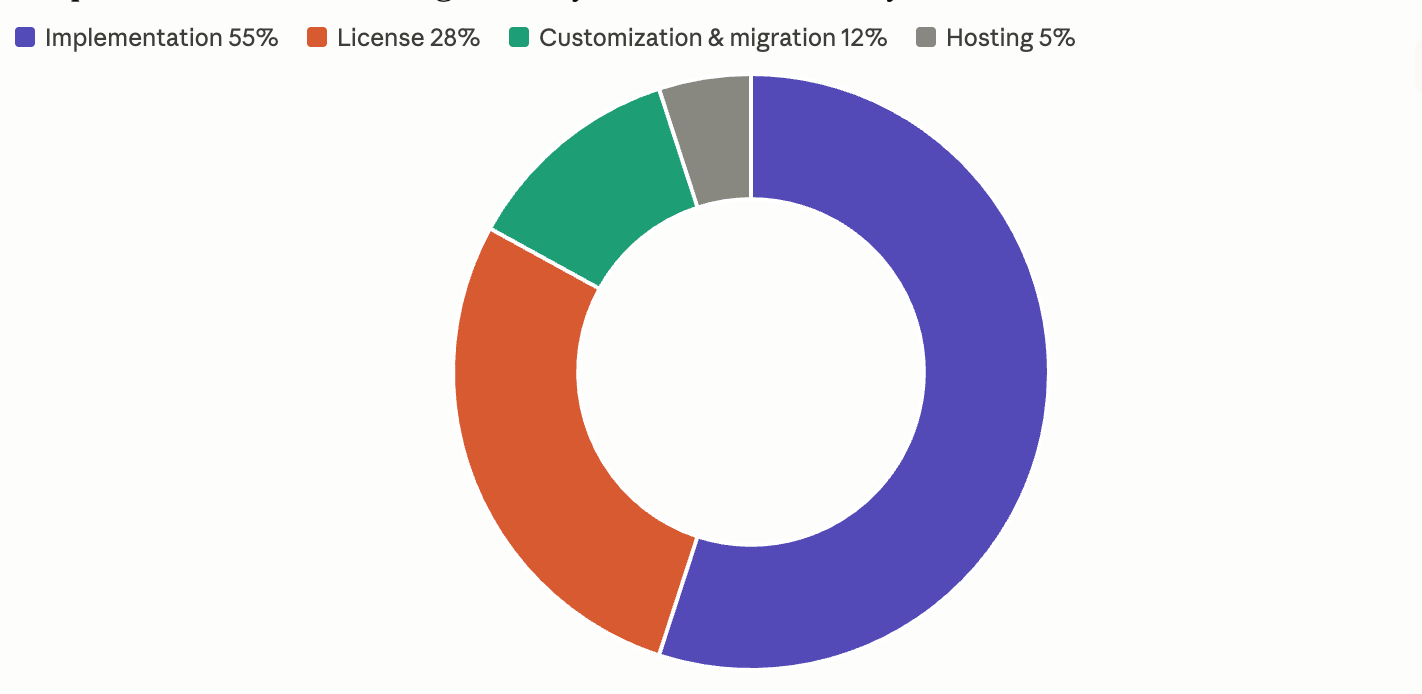
A useful rule of thumb: for a customized deployment, license is often 20–40% of Year-1 spend; implementation is the rest. Hosting is small in absolute terms but it’s the cost you can most directly control — which is why it’s worth understanding the options properly.
Odoo Hosting Costs Compared
If you’re on a Custom plan, hosting is one of the few recurring costs you actively choose. The models differ less in headline price than in how they scale.
| Hosting Option | Pricing Model | Best For | Typical Costs (Monthly) | Limitation |
|---|---|---|---|---|
| Odoo.sh | Per worker + storage + staging | Custom Enterprise deployments | from ~$70/worker + add-ons | Costs scale with usage |
| Managed Odoo Hosting | Flat plan | SMBs wanting hands-off ops | ~$25–$85 | Less low-level control |
| Unmanaged VPS | Flat plan | DIY developers | ~$10–$100 | You manage everything |
| AWS/Azure | Per resource + egress | Large enterprise | $150–$2,000+ | Heavy DevOps overhead |
The mechanic that matters: metered vs. flat
Odoo.sh meters three things separately. Each background worker starts at about $70/month, storage is billed at $0.25/GB/month, and every staging branch costs $18/month. A team that needs three workers and a staging environment is already at roughly $210/month for workers alone before storage — and before the mandatory Enterprise license, since Odoo.sh cannot run Community edition and requires an active Enterprise subscription.
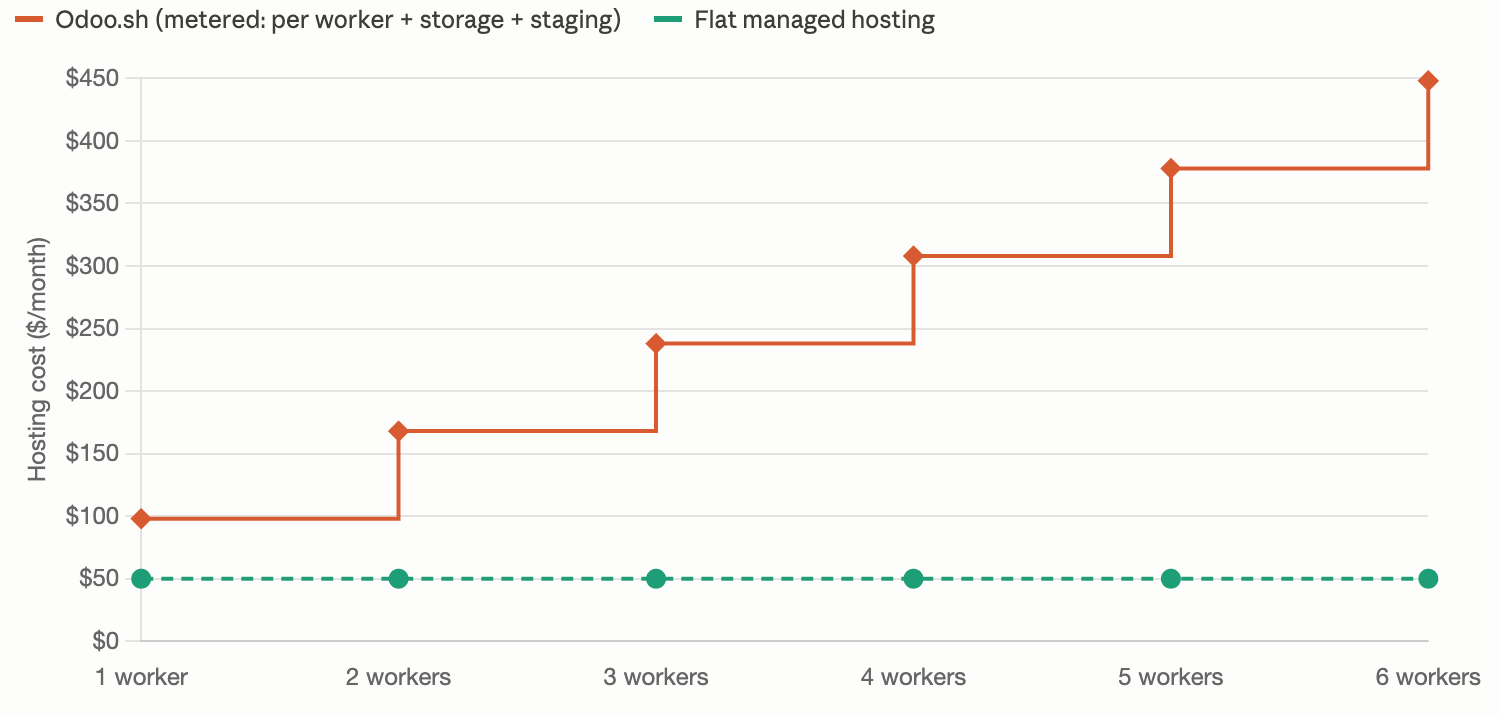
Flat managed and self-hosted models scale with server size, not meters. You pick a server tier and run as many workers, instances, and staging environments as that hardware supports. Growth shows up as an occasional server upgrade, not a creeping per-line bill.
Here’s the same workload — roughly 20–25 users, multiple workers, one staging environment, ~50GB — under each model:
| Cost Component | Odoo.SH | External Hosting (e.g. Host4Geeks) |
|---|---|---|
| Hosting base | from ~$70/worker/mo | Flat plan ($24.95–$84.95/mo) |
| Additional workers | +$70/mo each | Included (unlimited) |
| Staging environment | +$18/mo each | Included (one-click) |
| Storage | +$0.25/GB/mo | Included in plan |
| Community edition | Not supported | Supported ($0 license) |
| Renewal | Variable with usage | Flat, published rate |
For a Community-edition user the gap is even wider, because the flat-managed route carries no license cost at all — a structural saving the Odoo.sh model can’t reach at any server size.
Sizing tip: workers are the lever that drives Odoo performance, not raw users. A rough guide is one worker per ~6 concurrent active users, plus one for cron. On a metered platform that’s also your fastest-rising cost.
Compact preview of the Host4Geeks managed Odoo hosting banner at 706px width.
How Much Does Odoo Really Cost? 4 Worked Examples
These scenarios show how user count, scope, and infrastructure combine. Figures are illustrative but the math is transparent — you can swap in your own numbers. All license figures use US Custom-plan yearly rates.
Example 1 — Small e-commerce startup (5 users)
An online retailer leaving Shopify + QuickBooks for one unified system. Needs a third-party shipping connector, so it’s on the Custom plan despite its size.
- License: ~$3,000/yr (5 users × ~$49/mo, yearly)
- Hosting: ~$300/yr (entry managed plan)
- Year 1 total: ~$3,300
Example 2 — Professional services agency (25 users)
A consultancy consolidating CRM, projects, and timesheets. Wants a permanent staging environment for safe workflow changes.
- License: ~$14,700/yr (25 users)
- Hosting: ~$600/yr (mid managed plan, staging included)
- Year 1 total: ~$15,300
Example 3 — Mid-market manufacturer (60 users)
A hardware maker running MRP, PLM, Quality, and Inventory with heavy compute peaks. Hosts on a dedicated tier to keep MRP runs fast.
- License: ~$35,300/yr (60 users)
- Hosting: ~$1,200/yr (high-resource plan)
- Year 1 total: ~$36,500
Example 4 — Multi-location retail chain (100 users)
10+ stores needing a unified backend and resilient local POS. Multiple instances managed from one dashboard.
- License: ~$58,800/yr (100 users)
- Hosting: ~$3,000/yr (clustered/high-tier setup)
- Year 1 total: ~$61,500
How to Reduce Your Odoo TCO
You can cut Odoo cost without weakening the system by targeting the recurring drivers.
Bill annually. Yearly billing saves roughly 20% on Enterprise licenses versus monthly. Multi-year terms can lock in rates, though the savings curve flattens after two years — the 2-year term is usually the sweet spot.
Audit your users. You’re billed per internal user; portal users (customers, suppliers, website visitors placing orders) are free. Archive inactive internal accounts regularly.
Phase your rollout. Launch core modules first (Sales, Accounting), stabilize, then expand. It lowers the initial implementation bill and reduces future upgrade pain.
Keep customization tight. Use standard features wherever possible. Heavy customization inflates the build and every annual upgrade after it.
Choose hosting that scales with hardware, not meters. This is the most overlooked lever. Moving from a per-worker, per-storage model to a flat managed or self-hosted server caps your infrastructure cost as you grow — and if you run Community, it removes license fees entirely.
Hidden Costs to Watch For
Odoo’s license pricing is fairly transparent. The surprises live elsewhere.
Upgrade and refactoring debt. Annual upgrades are included, but your customizations aren’t automatically compatible. Skip several versions and a routine upgrade becomes a rewrite. Odoo also applies a support surcharge for databases several releases behind — technical debt that turns into financial debt.
Infrastructure creep. On metered platforms, storage, workers, and staging environments are billed separately and rise with growth. Attachments and document-heavy databases push storage costs up steadily; busy systems get nudged toward more workers.
Third-party module lifecycle. Many App Store modules ship with limited support windows. After that, fixes and version-bump compatibility cost extra. An SLA with your developer or partner mitigates this.
Data cleanup. Migration time scales with how messy your legacy data is. Validation — making sure migrated balances match the source — is routinely underestimated.
In-app purchase credits. Services like SMS, lead generation, and bill digitization run pay-as-you-go. They’re small individually but grow with usage.
Frequently Asked Questions
Is Odoo really free? Odoo Community edition is free to license under open source. You still pay for hosting, maintenance, backups, and upgrades. The paid Standard and Custom plans add Enterprise features and bundled hosting/support.
How much does Odoo cost for 10 users? On the Custom plan at US yearly rates, license alone is roughly $5,900/year (10 × ~$49/mo). Add hosting and a one-time implementation. On Odoo.sh you’d also pay per-worker, storage, and staging fees on top of the license; a flat managed plan folds hosting into a single predictable fee.
What’s the difference between Standard and Custom? Both include all apps. Custom adds Odoo Studio, external API access, multi-company, custom modules, and the ability to host on Odoo.sh or your own server. Standard has no custom code.
Why is Odoo.sh expensive? Because it meters several things at once — workers (from ~$70/mo each), storage ($0.25/GB/mo), and staging ($18/mo each) — and requires a mandatory Enterprise license on top. Costs scale with usage, so a growing deployment’s bill rises faster than the headline suggests.
Is there a cheaper alternative to Odoo.sh? Yes. Self-hosting or flat-rate managed Odoo hosting replaces per-worker metering with a fixed server cost, supports Community edition (no license fee), and keeps renewal pricing predictable.
The Bottom Line
Odoo’s cost can’t be judged by the license price alone. Cheap entry points hide operating costs, and metered hosting platforms get more expensive exactly as your business succeeds. The license is largely fixed by your user count and edition — where you actually control spend is implementation discipline and a hosting model that doesn’t tax you for growing.
Separate the software from the infrastructure, keep customization lean, and pick hosting that scales with hardware rather than meters. Do that, and Odoo stays affordable well past Year 1.
Recent Posts
 Implementing a 3-2-1 Backup Strategy for BusinessJuly 30, 2026
 High Availability 101: Setting Up a Load BalancerJuly 29, 2026
 Advanced Email Deliverability: SPF, DKIM, and DMARCJuly 29, 2026


Leave a Reply